Star Internet Services
Is It a Good Fit?
It depends on your location and needs. Here are some scenarios:
If you’re in rural / remote area where regular broadband is slow, expensive, or not available → Starline is often a great option.
If you need high bandwidth all the time (e.g. for multiple 4K streams, big uploads, etc.) → you might need a higher-tier plan or supplementary internet options.
If you care about latency for gaming → Starline is much better than traditional satellite internet; still, fiber or cable will often be superior if available.
If upfront cost matters → the hardware fee and installation might be a barrier compared to ISPs which include hardware or have cheaper install.
Weather / line-of-sight issues → critical if you have many trees, frequent storms, etc.
How Starline Performs
Download speeds in many U.S. areas are often 100-200 Mbps, sometimes more.
Latency (ping) is much lower than traditional satellite ISPs — around 20-40 ms in many tests.
Uptime is claimed by Starlink to be better than 99.9% on average.
Reliability is good but not perfect: weather (rain, snow, clouds), obstructions (trees, roof angle), peak‐demand periods can reduce speeds.
In some reviews, Starline gets down to lower upload speeds (often ~10-20 Mbps) depending on plan and region.
What “Fast & Reliable” Satellite Internet Means
Starline Internet

Whole Home Wi-Fi

Unlimited Data

Professional Installation!

How to Decide Which One Fits Best
If you are considering Starline (or evaluating what service you should subscribe to), here are some pointers:
If you have a fixed home and want reliable broadband and lots of data → Residential (or maybe Residential Lite if cost is a concern and you can tolerate lower priority at peak hours).
If you travel a lot, have an RV, or often move between locations → Roam / Mobile plans are designed for that.
If you need high throughput, business-grade reliability, or you work from home with high demands (video streaming, large uploads, etc.) → Business / Priority plans may justify the cost.
If you’re using a boat or are near water/coast, want use while moving → check whether the hardware supports in-motion / maritime usage.
If you just want emergency backup or messaging when you lose phone signal → the Direct-to-Cell options are useful and cheaper.
Things to Check for Where You Live
To pick something that will actually work well for you, check:
Line of sight / obstructions
Make sure the dish (if required) has a clear view of the sky in the needed direction. Trees, tall buildings, hills can block signals.
Weather patterns
If you are in a region with heavy rain, snow, or storms often, how does the provider perform under those? Some dishes are more weather-hardened.
Peak usage congestion
Sometimes during evenings or high-traffic periods, speeds drop. Reviews from people in your area help.
Hardware costs and support
Is there a big upfront cost? Is installation easy or difficult? What happens if parts fail?
Uptime guarantees / SLAs
Especially important if you depend on internet for work, business, or other critical tasks.
Plan features
Data caps? Prioritization? Upload vs download speeds? Latency? Hidden costs?
What is Starline Internet
Starline is a satellite Internet service operated by SpaceX. It uses a large constellation of low Earth orbit (LEO) satellites to provide broadband-internet access, especially targeting rural or remote areas where traditional wired Internet is hard or expensive to deploy.

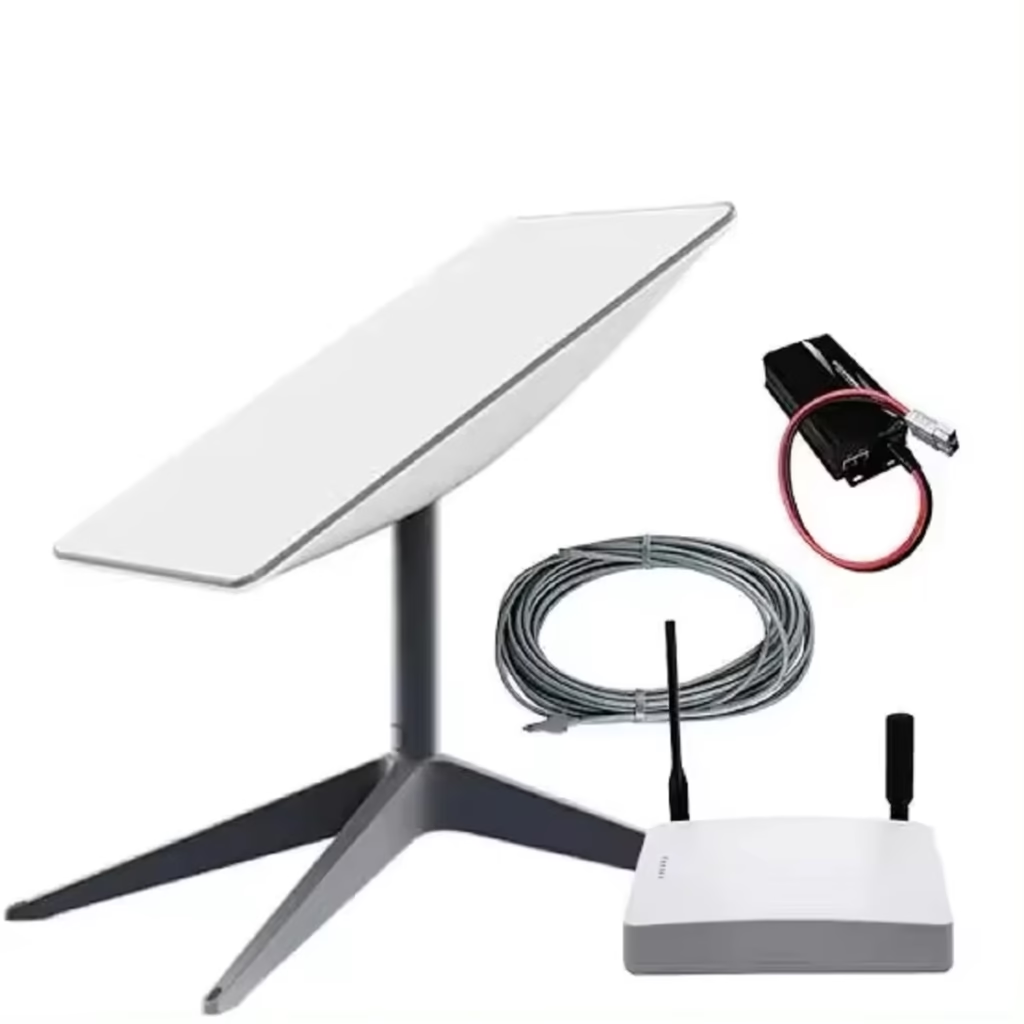
A user installs a terminal / dish (sometimes called “Dishy”) that communicates with the Starlink satellites overhead.
The terminal also connects to a router for distributing WiFi or wired connectivity in your place.
The satellites relay data down to ground stations (and increasingly via inter-satellite optical links) which connect to the Internet backbone.
Because the satellites are in low orbit (not geostationary), latency (signal-travel delay) is much lower than traditional satellite ISPs.
Download speeds are often in the 50-150 Mbps range for standard (residential) plans, sometimes more under good conditions.
Upload speeds are lower — often ~ 10-20 Mbps, depending on plan & location.
Latency is much better than older GEO satellite Internet, often 20-40 ms in many places.
The one-time cost for the standard hardware kit (dish + router etc.) is roughly US$ 599 in many places for the residential kit.
Monthly fees vary by plan type: Standard Residential service can be US$ 110-120/month in many US markets.
Business / priority / high capacity / mobility plans cost significantly more
Residential / Fixed service
for homes at a fixed location.
Roam / RV / Mobile
for users who travel, or move the terminal around; sometimes with less priority or with additional costs.
Priority / Business
higher speed, higher reliability, possibly priority traffic during network congestion.
Maritime / Aviation
for use on ships, flights, etc.; specialized hardware